Sunday, April 7, 2019

Jacques Hugues Picard dit Lafortune — Voyageur Grandfather


Jacques Hugues Picard dit Lafortune (1618-1707) 9th great-grandfather
son of Gabriel Picard dit LaFortune (1590-1660) and Michelle Clavier (1598-1660)
Birth ABT 1618 • St Columbin, Nantes, Bretagne, France
Death 22 DEC 1707 • Our Lady of Montreal, Quebec, Canada
Marriage 1660 to Antoinette Liercourt (1634-1707)

• 1653, arrived as part of La Grande Recrue de Montréal

• 1677, voyageur transporting goods to Fort Frontenac…

Frontenac took a census of Fort Frontenac: 7 September 1677 – Frontenac took a census of Fort Frontenac. Many of the men who would accompany La Salle on his future voyages were residents of the Fort. By this time, La Salle had made most of his improvements to the fort. Following are names of the individuals recorded in the census: La Salle (governor), François Daupin, sieur de LaForest (major), Louis Hennepin (a Récollet), Luc Buisset (a Récollet), Sieur Jean Péré. Soldiers: La Fleur (sergeant), Duplessis, La Boise, Jean Baptiste Fafard dit Macons/Macouce, Meunier/Meusnier dit Laliberté, Jean Michel, André Hunault, Deslauriers, Antoine Brossard (ordered to go to meet the Onondaga), Lévéille (gone down to Montréal to bring up the carpenter disembarked lately), Gabriel Barbier dit LeMinime/Mimine (ordered into the brigantine), Jacques Bourdon, sieur d’Autray (ordered into the brigantine), Maheu (ordered into the brigantine), Jean la Rouxelière/ Rouxcel de Larousselière (surgeon absent on duty), Cauchois/Cochois (a servant of sieur de La Salle, ordered into the brigantine), Fontaine (a pilot of the barque called Le Frontenac). Workers: Olivier Quesnel (an armorer), Moïse Hilaret (ship’s carpenter gone down to make a shallop in Lac St. Sacrament), Jean Fontaine (ship’s carpenter gone down to make a shallop in Lac St. Sacrament), Laforge (the blacksmith gone to take them), Pierre Lecellier, Jolycoeur, Louis Méline, Jean Baptiste Brossard, Dubois (tailor gone down to Montréal ten days ago, sick), Joseph (joiner gone down to Montréal ten days ago, sick), Louis Douceregnié, Larose/La Rosée (mason), Jean Baptiste Caron/Colon/Coron dit La Violette de Paris (mason), Thomas Brésil (mason), René Gervais (mason), Pierre Perrault/Perot (carpenter), Pierre Perrault/Perot (his son), Jean Barraud, Antoine Alain. Habitants: Curaillon, Jean Michaud (has his wife and four children), Jacques de LaMétairie, Mathurin Grégoire (wife and three children). In addition to the individuals named in the census, the following men brought supplies to Fort Frontenac: Lavigne, Bourbonnais, Charles Diel, [Jacques Hugues? not stated] Picard, Pigoret, Larivière de Tours, Charles Ptolomée, Nicolas Bonhomme, Nicolas Gagné/Gaigner, Laforge, and Charlier.44 

Source: French-Canadian Exploration, Missionary Work, and Fur Trading in Hudson Bay, the Great Lakes, and Mississippi Valley During the 17th Century – Part 6 – 1674 to December 1681 Diane Wolford Sheppard© 2010, 2014, FCHSM member (bluecolumbine@comcast.net) 


• 1688, 23 Jul - Jacques Hugues Picard engagement to Francois Balan dit Biron. No destination was given.

In the 1690s it appears that Hugues Picard is acting as a merchant trader and is hiring voyageurs. The archives of Quebec also list records of Jean-Gabriel and Jacques, two of his sons, engaged as voyageurs. 


• 1691, avril 29, Engagement de Jean Pottier à Hugues Picard—Antoine Adhémar.
1691, 29 Apr Engagement of Jean Pothier to Hugues Picard—Antoine Adhémar. P140


• 1691, 4 nov Engagement de Toussaint Pothier à Hugues Picard—Antoine Adhémar.
1691, 4 Nov, Engagement of Toussaint Pothier to Hugues Picard—Antoine Adhémar. P148


• 1693, 29 Apr — Eustache Prévost (1), Jean Sauviot, and their unnamed associates hired Jacques Picard to make a voyage to the 8ta8ois (Ottawa Indians), notary Antoine Adhémar. P200
(1693, 29 avril.—Engagement de Jacques Picard à Eustache Prévost, Jean Sauviot et autres associés, pour faire le voyage des 8ta8ois—Étude Adhémar.) 

(1) Eustache Prévost soldier (compagnie de La Motte) régiment de Carignan.  One of the fourteen trading colleagues, Eustache Prévost, hailed from Contrecoeur, which was located about halfway between Trois-Rivières and Montreal. According to researcher and author Timothy Kent he was a trading partner with Jean Dupuis and Antoine Bazinet.

LINEAGE:

Jacques-Hugues Picard dit Lafortune (1618 - 1707) -- 9th great-grandfather

Marie Anne Picard (1663 - 1697) -- Daughter of Jacques-Hugues Picard dit Lafortune

Charles Diel (1688 - 1734) -- Son of Marie Anne Picard

Marie Anne Diel (1727 - 1760) -- Daughter of Charles Diel

Marie Anne Dupuis (1753 - 1807) -- Daughter of Marie Anne Diel

Marie Angelique Barette dit Courville (1779 - 1815) -- Daughter of Marie Anne Dupuis

Marie Emélie Meunier Lagacé (1808 - 1883) -- Daughter of Marie Angelique Barette dit Courville

Lucy Pinsonneau (aka Passino) (1836 - 1917) -- Daughter of Marie Emélie Meunier Lagacé — 2nd great-grandmother

Saturday, April 6, 2019

Francois Leber — Voyageur Grandfather


Francois Leber (Lebert) (1626-1694) 8th great-grandfather
son of Robert LeBer (1601-1625) and Colette Cavelier (1605-1694)
Birth 1626 • Rouen, Seine-Maritime, Haute-Normandie, France
Death 19 MAY 1694 • La Prairie-de-la-Madeleine, Quebec, Canada
Marriage (1) to BEF 1656 to Marguerite Leseur (1628-1662) (2) 1662 to Jeanne Testard
(1642-1723) (8th great-grandmother)

• 1681, Settled in the seigniory of La Prairie-de-la-Madeleine before September 1674, when his son Claude was born. When the 1681 census was conducted, my ancestor families living in La Prairie included: Pierre Gagne (7), Francois Leber (5), Charles Boyer (5), Pierre Peras (8), Charles Diel (4) and Jeanne Denote (6); a total of 35 inhabitants. All of them were involved in the fur trade.

• 1688, Coureur des Bois, trip to the 8ta8ats (Ottawa Country). Probably on behalf of his brother Jacques LeBer and his partner Charles Le Moyne.


• 1693, Aug 31—Engagement of François Le Ber to de Claude Caron aux sieurs Guillaume Boucher for a trip to the 8ta8ats (Ottawa Country)—Notary Maugue, Archives of Quebec, page 200.


Notes: By 1684, Francois’ brother Jacques LeBer and his partner Charles Le Moyne had a store in Montréal where they bought furs for France. In 1686, Jacques was given permission by the governor of the colony to trade for furs with the Outaouais (Ottawas) and LeBer gave the privilege for this trade in beaver pelts to Jean Paschal Prevost and Jacques Testard that July. The two came back with their canoe loaded with beaver pelts. However, Jean Paschal did not get rich from this trade as he and Jacques already had big debts owed to the merchants for this privilege and Jean Paschal would be quite constantly in debt and frequently in conflict over debts with his siblings.

From: "Narratives and ldentities in the Saint Lawrence Valley, 1667-1720”

[page 170]
Jacques Leber was one of the wealthiest men in Montreal. His independence emerged early in his life and seems to be characteristic of the man. In 1662 he was arrested for sedition because he advocated a fur trading plan that the (New France) Governor would not allow. 

It is clear that the Leber family worked together in business affairs. The exact nature of the arrangements is not immediately apparent. 

It appears that François Leber père (father of Anne and Joachim, and Jacques' brother) lived in Montréal for a number of years, boarding in various houses, including the house of la veuve l'Espérance, rue Place d'Armes. 

His son, François, apparently transported goods and money across the river from LaPrairie to his father. While the younger François was away, which was often, a neighbor, Claude Caron, transported goods and money to François. 

François Leber was a prisoner of the Iroquois in October, 1693, there is yet another Leber out of the colony, just a year after his brother was interrogated.

François Leber. along with Guillame Boucher, was engaged by Claude Caron August 31. 1693, RAPQ, volume 10,201. It is a possibility that residents of La Prairie sold liquor to the Indians in order to obtain hard currency, which was then transported to Montreal to settle debts or to loan to others, including the government.

From: “Minnesota, eh?,” published by French-American Heritage Foundation
LaPrairie grew between 1694 and 1697 as Iroquois hostilities diminished. A number of new residents sought refuge there, including merchants, craftsmen and skilled workers. By 1697, the fortification enclosed 120 persons, among them Charles and Jacques Deneau, Francois Leber, Denis Brosseau, Francois Bourassa and Claude Guerin.

LINEAGE:

Francois Leber (Lebert) (1626 - 1694) -- 8th great-grandfather

Marie Le Ber (1666 - 1756) -- Daughter of Francois Leber (Lebert)

Marie Elisabeth Bourassa (1695 - 1766) -- Daughter of Marie Le Ber

Joseph Pinsonneau (Pinsono) (1733 - 1784) -- Son of Marie Elisabeth Bourassa

Gabriel Pinsonneau (Pinsono) (1770 - 1807) -- Son of Joseph Pinsonneau (Pinsono)

Gabriel Passinault) (aka Gilbert Passino) (1803 - 1877) -- Son of Gabriel Pinsonneau (Pinsono)


Lucy Passino (Pinsonneau) (1836 - 1917) -- Daughter of Gabriel Passinault) (aka Gilbert Passino) -- 2nd great-grandmother


Moïse Dupuis — Voyageur Grandfather


Moïse Dupuis (Depuis)(Dupuys)(Dupays) (1673-1750) 7th great-grandfather
son of Francois Dupuis (Dupays) (1634-1681) and Georgette Richer(1647-1799)
Birth 10 JULY 1673 • Québec, Quebec, Canada
Death 19 JAN 1750 • La Prairie-de-la-Madeleine, Quebec, Canada
Marriage 1699 to Marie Anne Christiansen (1676-1750)

• 1692, Courier de Bois and trader in the illicit trade between La Prairie, Quebec at Schenectady, NY
• from: Narratives and Identities in the Saint Lawrence Valley, 1667-1720, 

[page 186] Moise Dupuis was bom in 1673 in Québec and raised at Saint-Augustinde-Maure and at La Prairie. Moïse may have been involved in the fur trade as a young man. He was never issued a permit for travel? He may have been a soldier; however, since no muster rolls exist for Canada in this period. and he is not mentioned in accounts of military engagements, that possibility cannot be confirmed. He was linked to large fur trading families. however. 


Coureur des Bois by Remington

[page 187] Moïse may have been among the French who attacked Schenectady in 1692. He seems to have remained in Schenectady, either as a trader, a wounded soldier or as a prisoner, long enough to find a spouse. In the 1690s he married Marie-Anne- Louise Christiansen" Wans le pays des Flamands." This exogamy, or marriage outside the group, contrasts with the endogamy noted by Louis Lavallee in his study of La Prairie." Moïse moved, with a young daughter, to Canada, settling in La Prairie about 1699. Marie-Anne-Louise was probably Dutch and nominally Protestant, though the Dutch Reformed Church could not support a minister in Schenectady during this period.* When Marie-Anne-Louise moved to La Prairie she was baptized in Montréal.' Since at the time of her baptism her marriage was not revalidated, it is possible that they were married by a Catholic priest. At least one, perhaps three, of the couple's nine children were born outside New France, although most of them were baptized at La Prairie?

[page 188]

Most of MoÏse's children maintained a residence at La Prairie, or married spouses from La Prairie families. One daughter married a man who had been an engagé in the fur trade." Marie-Anne-Louise became a French citizen in 1710. Moïse and Marie-Anne-Louise died in La Prairie, in January and October 1750, respectively. Moïse is an example of a man who traveled the border region, married outside the colony, and returned to live on the banks of the St. Lawrence with a Dutch wife who eventually became a French citizen.


• 1697, 12 Jul — Marriage of Moyse Dupuis to Anne (Annetje) Christiansen in Schenectady (Albany), New York, United States.
SOURCE: US DUTCH REFORM Church Records, New York, Albany, Vol 1, Book 1; Family: Dupuis Moyse/Christian (F1328)

LINEAGE:

Moise Dupuis (Depuis) (1673 - 1750) -- 7th great-grandfather

Francois Moise ( François) Dupuis (Dupuy) (1709 - 1764) -- Son of Moise Dupuis (Depuis)

Marie Anne Dupuis (Dupuy) (1753 - 1807) -- Daughter of Francois Moise ( François) Dupuis (Dupuy)

Marie Angelique Barette dit Courville (1779 - 1815) -- Daughter of Marie Anne Dupuis

Marie Emélie Meunier Lagacé (1808 - 1883) -- Daughter of Marie Angelique Barette dit Courville

Lucy Pinsonneau (aka PASSINO) (1836 - 1917) -- Daughter of Marie Emélie Meunier Lagacé -- 2nd great-grandmother


Charles Diel dit Le Petit Breton — Voyageur Grandfather

Frontenac en route to Cataracoui


Charles Diel dit Le Petit Breton (1652-1702) 8th great-grandfather
son of Philippe Diel (1618-1676) and Marie Anquetin (Hanquetin) (1630-_)
Birth BEFORE 1652 • Rouen, Seine-Maritime, Haute-Normandie, France
Death 13 APR 1702 • La Prairie-de-la-Madeleine, Quebec, Canada
Marriage 1676 to Marie Anne Picard (1663-1697)

• 1665, arrived in New France as a soldier in the La Fouille Company of the Carignan-Salières Regiment.

• 1673, Charles in one of the earliest habitants of La Prairie de la Magdeleine.

• 1677, Charles Diel transports supplies to Fort Frontenac

Frontenac took a census of Fort Frontenac: 7 September 1677 – Frontenac took a census of Fort Frontenac. Many of the men who would accompany La Salle on his future voyages were residents of the Fort. By this time, La Salle had made most of his improvements to the fort. Following are names of the individuals recorded in the census: La Salle (governor), François Daupin, sieur de LaForest (major), Louis Hennepin (a Récollet), Luc Buisset (a Récollet), Sieur Jean Péré. Soldiers: La Fleur (sergeant), Duplessis, La Boise, Jean Baptiste Fafard dit Macons/Macouce, Meunier/Meusnier dit Laliberté, Jean Michel, André Hunault, Deslauriers, Antoine Brossard (ordered to go to meet the Onondaga), Lévéille (gone down to Montréal to bring up the carpenter disembarked lately), Gabriel Barbier dit LeMinime/Mimine (ordered into the brigantine), Jacques Bourdon, sieur d’Autray (ordered into the brigantine), Maheu (ordered into the brigantine), Jean la Rouxelière/ Rouxcel de Larousselière (surgeon absent on duty), Cauchois/Cochois (a servant of sieur de La Salle, ordered into the brigantine), Fontaine (a pilot of the barque called Le Frontenac). Workers: Olivier Quesnel (an armorer), Moïse Hilaret (ship’s carpenter gone down to make a shallop in Lac St. Sacrament), Jean Fontaine (ship’s carpenter gone down to make a shallop in Lac St. Sacrament), Laforge (the blacksmith gone to take them), Pierre Lecellier, Jolycoeur, Louis Méline, Jean Baptiste Brossard, Dubois (tailor gone down to Montréal ten days ago, sick), Joseph (joiner gone down to Montréal ten days ago, sick), Louis Douceregnié, Larose/La Rosée (mason), Jean Baptiste Caron/Colon/Coron dit La Violette de Paris (mason), Thomas Brésil (mason), René Gervais (mason), Pierre Perrault/Perot (carpenter), Pierre Perrault/Perot (his son), Jean Barraud, Antoine Alain. Habitants: Curaillon, Jean Michaud (has his wife and four children), Jacques de LaMétairie, Mathurin Grégoire (wife and three children). In addition to the individuals named in the census, the following men brought supplies to Fort Frontenac: Lavigne, Bourbonnais, Charles Diel, Picard, Pigoret, Larivière de Tours, Charles Ptolomée, Nicolas Bonhomme, Nicolas Gagné/Gaigner, Laforge, and Charlier.44 

Source: French-Canadian Exploration, Missionary Work, and Fur Trading in Hudson Bay, the Great Lakes, and Mississippi Valley During the 17th Century – Part 6 – 1674 to December 1681 Diane Wolford Sheppard© 2010, 2014, FCHSM member (bluecolumbine@comcast.net) 


View of Cataraqui (Kingston)


FROM: CHARLES DIEL, OUR FIRST CANADIAN ANCESTOR…
(www.guiel.com/genealogy/charlesdiel1.htm)


BENIGNE BASSETT NOTARY RECORD, PAGE 262


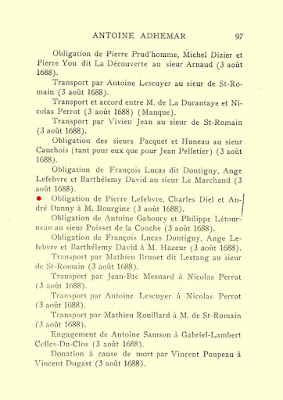
• 1684, Leger Hebert of Cap de la Trinite has a trade permit and hires Charles to go to the Outaouais country with Pierre Lefebvre and Antoine Caille on 20 September 1684 for the sum of 630 livres. Because they had never been there before, they are guided by Jean Lesieur dit La Calot who promises to lead them to Michillimakinac without receiving part of their share. That same day, they borrow the value of "2616 livres and six sols" of merchandise. (SEE 1684 CONTRACT BELOW)

• 1688, Jean Deniau guarantees them other trips for Hilarie Bourgine. The first voyage is followed by a second in 1688. On 31 July of that year, he promises Antoine Caille to go to the Outaouais to "put forward the good of their association". On the third of August, with Pierre Lefebvre and Andre Danny, he borrows 1063 livres, 2 sols, and six sums of money from Hilarie Bourgine, and, on the same day, in company of Antoine Caille and Pierre Lefebvre, 81 livres, 15 sols and six deniers from the same. On 20 October 1704, he rents to his son-in-law, Francois Bory, for five years, the land of St. Lambert, Laprairie. He sells the moist land to Nicolas Varrin dit Lapistole on 24 July 1707 for the sum of 600 livres.


ANTOINE ADHEMAR NOTARY RECORD, PAGE 96

ANTOINE ADHEMAR NOTARY RECORD, PAGE 97


FROM: CHARLES DIEL AND THE FUR TRADE…
(www.guiel.com/genealogy/charlesdiel1.htm)

In 1684 the country known as Canada or New France, that is to say the shores of the St. Lawrence River, counted about 10,700 settlers. Very few compared to the 160,000 inhabitants of the English colonies to the south.

In the middle of June 1684, the then Governor of New France, 62 year old Joseph Antoine Lefebvre de la Barre, who replaced Frontenac in 1682, writes to Thomas Dongan, the Governor of the colony of New York, to ask him not to give arms to the Iroquois and to let the French attack them. The Iroquois, specifically the Tsonnontouan, one of the five nations, are damaging the fur trade.

On 31 July 1684 King Louis XIV writes to la Barre saying that he wishes to diminish as much as possible the number of Iroquois and asks that the Iroquois be made prisoners on French convict ships "as they are strong and robust". On 1 September la Barre answered his King by writing that "he is preparing everything to exterminate this nation". After having sent Ambassadors to the different Iroquois nations to advise them that the French will only make war on the Tsonnontouans (1) the army of la Barre leaves Montréal 30 July 1684. His army is made up of 130 regular soldiers, of a militia of 700 Canadiens, and of 378 Indians. Already 80 soldiers have left ahead of the rest to prepare the terrain by cutting branches, etc. Also, a further movement of 200 Frenchmen and 500 Indians leave the Michillimakinac fur trading post to go to Niagara and await further orders there.


Fort Michilimackinac by William Dashwood


In the meantime the leaders of the Onneiouts or Oneida (2) don't understand why the French want to make war on the Tsonnontouans since they say they are ready to pay for any damages they have done to the Coureurs des Bois and the fur business and to apologize.

On 9 August, la Barre and his army reached the fort of Cataracoui. On this date, the Governor apparently after the pressures of Father Jean de Lamberville not to make war, decides to negotiate instead of attacking. But the main reason is probably that his army is already low on supplies and his soldiers are sick and in bad shape. He cannot attack. The Iroquois know it, and la Barre ends up having to accept all the conditions demanded by the Iroquois. A peace treaty is signed in the middle of August 1684. Very soon after, the King who is not pleased fires Mister la Barre.

It is a little bit more than a month after these events that Charles Diel prepares to leave on a fur trip and a contract is created for that effect. It is possible that Charles Diel was part of the Canadian militia and got permission to go on the fur trip because of his services.

In order to have merchandise to exchange with the Indians for furs, Charles Diel and his partners buy at credit a substantial amount of merchandise from a Montréal merchant. The contract refers to that transaction. The amount borrowed, 2616 livres, represents almost 10 years of salary for a qualified worker of the time.

Charles Diel is 31 years old at the time of the trip to Michillimakinac and has been married to Marie Anne Picard for 8 years. He traded for furs with the Indians in the middle of the Great Lakes at Ft. Michillimakinac. However, he was at his daughter's burial on or about 9 DEC 1684, so he did not winter over on this trip.
On 16 SEP 1692, Charles Diel, Antoine Cailler, and Pierre Le febvre appeared at a judicial hearing concerning a payment in fur to Madame Perrot of Laprairie with furs that they apparently transported from Michillimakinac to Montreal for a third party.. ???? pg. 95 Edge of Empire

(1) Les Sénécas ou Tsonnontouans sont un peuple amérindien d'Amérique du Nord qui faisait partie de la Confédération iroquoise. {English} Senecas or Tsonnontouans are a Native American people from North America who were part of the Iroquois Confederacy (2) Onneiouts or Oneida are a Native American people from North America who were part of the Iroquois Confederacy.

1684 CHARLES DIEL CONTRACT (TRANSLATED FROM FRENCH)…


page 1 — Contract dated 23 September 1684

23 September 1684

Obligation by Pierre Lefebvre, Anthoine Cailler, Charles Diel to Sr Hyllaire Bourgine

In front of Beninge Basset, Royal Notary in the land and lordship of L'Isle de Montreal in New France, appeared the undersigned witnesses, the Sirs Pierre Lefebvre, Antoine Cailler, and Charles Diel, inhabitants residing ordinarily in La Prairie St. Lambert, of present on the River de Montreal, which have recognized and confessed to owe much for himself, alone, and (for) each of the others, and for all, without discussion (litigation?) nor division, renounced (waived) the said division and surety to Sir Hillaire Bourgine, bourgeois merchant of the said Montreal, there residing at the present, and accepting the sum of two thousand six hundred and sixteen Livres six sols because of the merchandise that the said debtors have renounced and confessed have been given and delivered to them by him, Sieur Créancier, (the creditor, Sieur Bourgine) for the voyage and that they leave presently to the wilds of Ottawa? following the permit which was given to Sr Leger Hebert by Monsignor the Général, Governor and Lieutenant for the King in this


end of page

page 2 — Contract dated 23 September 1684

country of New France and dated of twenty-four May last, and for transportation that was done by the debtors for the said Mister Hébert by an act made and passed in front of said notary the twentieth of the said month of September to him this year. if agreed with said payment of which sum of two thousand six hundred and sixteen pounds six sols  the said debtors have pledged, promised, binding themselves jointly and severally, agreed, to pay to the said Sieur Bourgine in good fur in the courtyard in this country, and at the base of the general storehouse in this land, and this not later than the end of the month of September of next year which will count (number?) one thousand six hundred eighty-five. And for the execution hereof, the said debtors have elected their irrevocable home in this said city in the home of Mr. Jean Aubuchon dit Lespaerance (unreadable). by thus promising and obliging, (? each in right himself ?), the said declare severally as void.

end of page

page 3 — Contract dated 23 September 1684

Renouncement drawn up and passed at the Montreal office of the said notary one thousand six hundred eighty-four the third day of September after noon in the presence of Mister Jean Gamache, in the presence of Cailler, witnesses, and living in with said Cailler, the said Lefebvre and Diel having declared not knowing how to write or sign when asked following the ordinance.
Cailler
BASSET (paraphe)

end of contract — page 3

Ref#1568

PEOPLE MENTIONED IN THE CHARLES DIEL NARRATIVE…

JEAN AUBUCHON: He was murdered in his bed while on a business trip to Montreal. He was Elizabeth Aubuchon's great-grandfather. Elizabeth married Antoine Diel, Charles Diel and Marie Anne Picard's grandson, in Kaskaskia.
BENIGNE BASSET: Bénigne Basset was the first notary of Ville-Marie (Montréal). He was also a Land-Surveyor and registrar. He was born in 1639 making him 45 years old at the time of the writing of this contract. His "dit" name was des Lauriers. He arrived in Montréal around 1657 and died in 1699.
ANTOINE CAILLÉ (CAILLER): Antoine Caillé was a Blacksmith. Born around 1647 he is therefore 37 years old at the time of the fur trip. His dit names were "Brulefer and Biscornet ". Origin unknown. He married Anne Aubry in Laprairie around 1674. He was a servant at the Québec seminary in the years 1667/1668. He was recruited to go to war against the Tsonontouans, and as reward for his services against the Iroquois he is given a "congé" or leave to go on a fur trip in 1688. (This "congé" he will sell to André Danny or Dauny who will go with Charles Diel on his 1688 fur trip)
JEAN DENIAU: Jean Deniau was born in 1629, making him 55 at the time he acted as guarantor for Charles Diel and his partners. His parents were from Brittanie. He married Helene Dodin (Daudin) 25 NOV 1663. He came to New France with the "Grande Recrue" of 1653, arriving in Quebec on 22 SEP 1653 aboard the same ship with Hugues Picard, father of Marie Anne Picard. He was Marie Anne's god father. Jean Deniau and Helene Dodin were killed by the Iroquois on 12 AUG 1695.
PIERRE LEFEBVRE: Pierre Lefebvre was a neighbor of Charles Diel owning land in the Mouillepieds (wet feet). Born in 1648, dead in 1694. He is therefore 36 years old at the time of the trip. He is the son of Robert Lefebvre and Jeanne Autin of Sainte-Trinité de Bois-Guillaume, near Rouen. (In present day France, in Bois-Guillaume there are people with the family name of Dyel). He therefore was also from Normandie like Charles Diel. He married Marie Gagné. The day after adhering to the contract he sells his barge and all his riggings to Antoine Brunet for the amount of 240 livres. And on 15 October 1684 he pays back an amount of 27 livres to Jacques Beauvais. Therefore, the partners must have left for their fur expedition after that date, it must already have been quite cold when they left for good. Pierre Lefebvre will also go on a fur trading expedition with Charles Diel in 1688.
JEAN LESIEUR dit La Calot (the guide): Jean Lesieur was born in 1651. He is therefore 33 years old in 1684. Origin unknown. He married Marie Charebert around 1672. He lives in Champlain and is involved in the fur trade. In 1678, owing money to Jean Lemoyne, his grain is seized. Around 1684 he must have moved into the Seigneurie of Sainte-Trinitée. He signs another fur trading contract 17 May 1685 with other people.

LINEAGE:

Charles Diel dit Le Petit Breton (1652 - 1702) -- 8th great-grandfather

Charles Diel (1688 - 1734) -- Son of Charles Diel dit Le Petit Breton

Marie Anne Diel (1727 - 1760) -- Daughter of Charles Diel

Marie Anne Dupuis (1753 - 1807) -- Daughter of Marie Anne Diel

Marie Angelique Barette dit Courville (1779 - 1815) -- Daughter of Marie Anne Dupuis

Marie Emélie Meunier Lagacé (1808 - 1883) -- Daughter of Marie Angelique Barette dit Courville

Lucy Pinsonneau (aka PASSINO) (1836 - 1917) -- Daughter of Marie Emélie Meunier Lagacé -- 2nd great-grandmother


Friday, April 5, 2019

Gabriel Lemieux — Voyageur Grandfather

Rapides, rivière des Outaouais

Gabriel Lemieux (1626-1700) 9th great-grandfather
son of Louis Lemieux (1600-1665) and Marie Luguan (1600-1669)
Birth 10 APR 1626 • Rouen, Seine-Maritime, Haute-Normandie, France
Death 2 DEC 1700 • Québec, Quebec, Canada
Marriage 1658 to Marguerite Leboeuf (1636-1671)

We know from early notary records, in the archives of Quebec, that Gabriel Lemieux made at least two legal trips as a voyageur.  It's a safe bet that he made other trips as a coureur de bois.

1670, 17 Jun — Engagement de Jean Bucquet à Gabriel Lemieux, Notary-BECQUET, Romain Québec. [no image file, only text].

• Actes Notariés de Longueuil


Original hand-written notary record

1690, 8 mai.-—Engagement de Gabriel Lemieux à Migeon de Branssat pour faire le voyage au pays des 8ta8ois—Étude Adhémar. 
1690, May 8th .— Gabriel Lemieux's engagement to Migeon de Branssat to make the trip to the country of the 8ta8ois-Notary Adhémar.
• Archives de Quebec (1670-1745), P198


Original hand-written notary record

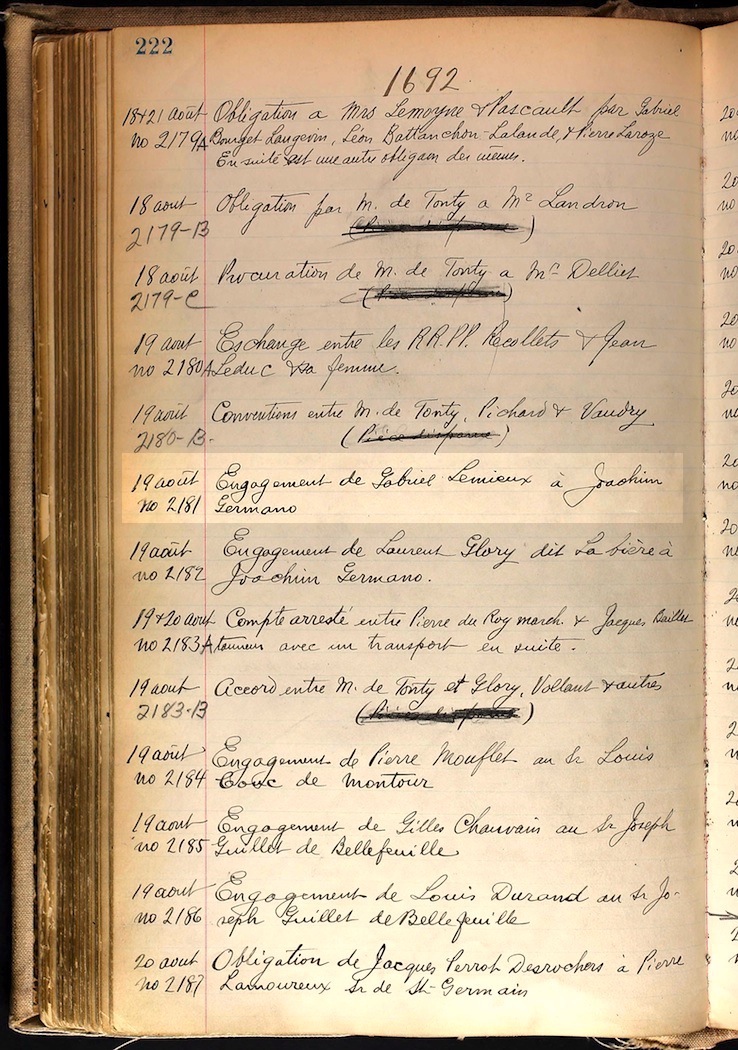
1692, 19 août.—Engagement de Gabriel Lemieux à Joachim Germano pour faire le voyage des 8ta8ois—-Étude Adhémar. 
1692, August 19.—Engagement of Gabriel Lemieux to Joachim Germano to make the trip of the 8ta8ois - Notary Adhemar.
• Archives de Quebec (1670-1745), P200

LINEAGE:

Gabriel Lemieux (1626 - 1700) -- 9th great-grandfather

Gabriel Lemieux (1663 - 1739) -- Son of Gabriel Lemieux

Marie Anne Lemieux (1706 - 1777) -- Daughter of Gabriel Lemieux

Marie Josephe Poupart (1725 - 1799) -- Daughter of Marie Anne Lemieux

Pierre Barette dit Courville (1748 - 1794) -- Son of Marie Josephe Poupart

Marie Angelique Barette dit Courville (1779 - 1815) -- Daughter of Pierre Barette dit Courville

Marie Emélie Meunier Lagacé (1808 - 1883) -- Daughter of Marie Angelique Baret (Barette) dit Courville

Lucy Pinsonneau (aka PASSINO) (1836 - 1917) -- Daughter of Marie Emélie Meunier Lagacé -- 2nd great-grandmother


Pierre Poupart — Voyageur Grandfather


Pierre Poupart (1653-1699) 8th great-grandfather
son of Jean Poupart (1625-1682) and Marguerite Frichet (1625-1682)
Birth Abt. 1653 • Bobigny, Paris, Ile-de-France, France
Death 7 JUN 1699 • La Prairie-de-la-Madeleine, Quebec, Canada
Marriage 1682 to Marguerite Perras dit La Fontaine (1665-1708)


1670, Pierre Poupart, 8th great-grandfather, signed on as a voyageur to accompany explorers Daumont de Saint-Lusson and Nicolas Perrot when they claimed the Great Lakes for France…

On 3 Sept. 1670 Intendant Jean Talon appointed Simon-François Daumont de Saint-Lusson a deputy commissioner “to seek out the copper mine in the country of the Ottawas, the Nez-Percés [Amikoues], and the Illinois, and of other nations discovered or to be discovered in North America in the region of Lake Superior or Freshwater Sea.” 

Nicolas Perrot was asked by Talon to accompany Daumont de Saint-Lusson as an interpreter.  Perrot then formed a new trading company, this time with Jean Dupuis, Denis Masse, Pierre Poupart, Jean Guytard and Jacques Benoît, and set out with Saint-Lusson. 

What was being undertaken was a systematic study of the country, following the accounts brought back by the first travelers and the details supplied by the first explorers Cavelier de La Salle, Bréhant de Galinée, Dollier de Casson, Adrien Jolliet, and Marquette.


Indeed Daumont de Saint-Lusson, as well as making soundings at the Lake Superior copper mine, was to attempt to discover the northwest passage in a northerly direction, whereas La Salle was instructed to proceed towards the “southern sea.” It was Talon’s reply to the English expansion into Hudson Bay.

Saint-Lusson, accompanied by the interpreter Nicolas Perrot, left Montreal in October 1670 via the Ottawa River, Lake Nipissing, the Rivière des Français (French River), and the Great Lakes; he went ashore at the village of Sault Ste. Marie, where the Jesuits maintained a fairly prosperous mission. 

On 4 June 1671 he called together all the Indian nations that could be reached; there were 14 of them.  In the presence of this important gathering of nations and a few prominent Frenchmen a ceremony took place which had important diplomatic consequences. 

The interpreter Perrot, in the name of the king of France, began to read in the Indian language from the document that confirmed the appropriation by France of this immense territory, discovered and yet to be discovered, which stretched from the seas of the north and west to that of the south. 


Then they erected a cross, “to bring forth there the fruits of Christianity,” and immediately beside it a cedar post bearing the arms of France. As the crowd, made up of both French and Indians, uttered repeated cheers of “Long live the king,” a “sod of earth” was lifted in the air three times, in a symbolic gesture. Henceforth this part of a continent belonged to the king of France, and these 14 nations were dependent on His Majesty and subject to his laws and customs.  In return they could count on his protection. 

The French intoned the Vexilla Regis, to the great wonderment of the Indians. Then Father Allouez delivered a harangue to the Indians in which he extolled the power of Louis XIV, “the Captain of the greatest Captains.” 

Daumont de Saint-Lusson then spoke, and expressed himself “in martial and eloquent language.” In the evening a splendid bonfire was lighted, presents were exchanged, and aTe Deum was sung to thank God, in the Indians’ name, for having made of them “the subjects of so great and powerful a Monarch.”

Some Hurons and Ottawas, who arrived late for the ceremony, likewise swore allegiance to Louis XIV. Saint-Lusson’s official journey, which cost the king of France nothing and which added a segment – somewhat symbolically it is true – to his empire, in fact marks the beginning of the planned explorations that were to lead to James Bay, the Gulf of Mexico, and the Rocky Mountains.

Source: FRENCH-AMERICAN HERITAGE FOUNDATION OF MINNESOTA, Nicolas Perreault Article


• 1685, Jul. 23, Agreements between Pierre Poupart, Joseph Demers and Jean Perras dit Lafontaine of the Prairie de la Madeleine, for the voyage of the Outaouais [Ottawas].
• Records of Notary Hilaire Bourgine 1948 P15


• 1685, aout. 4, Obligation by Pierre Poupart of the Prairie de la Madeleine to François Hazeur, for 132 books eighteen sols eleven deniers for goods, payable on return from his trip to the Ottawa.
• Records of Notary Hilaire Bourgine 1948 P16

NOTE: Pierre Poupart died on 07 Jun 1699 in LaPrairie de la Madeleine, Quebec, Canada; where he was killed by the Iroquois at age 40.


LINEAGE:

Pierre Poupart (Poupard) (1653 - 1699) -- 8th great-grandfather

Joseph Poupart (1696 - 1726) -- Son of Pierre Poupart (Poupard)

Marie Josephe Poupart (1725 - 1799) -- Daughter of Joseph Poupart

Pierre Barette dit Courville (1748 - 1794) -- Son of Marie Josephe Poupart

Marie Angelique Barette dit Courville (1779 - 1815) -- Daughter of Pierre Barette dit Courville

Marie Emélie Meunier Lagacé (1808 - 1883) -- Daughter of Marie Angelique Barette dit Courville

Lucy Pinsonneau (aka PASSINO) (1836 - 1917) -- Daughter of Marie Emélie Meunier Lagacé -- 2nd great-grandmother


Thursday, April 4, 2019

Jean Baptiste Desroches — Voyageur Grandfather


Jean Baptiste Desroches (1621-1684) 8th great-grandfather
son of Jean Antoine Desroches (1585-1652) and Antoinette Unknown (1585-_)
Birth 1621 • Le Bois, Haute-Loire, Auvergne, France
Death 23 AUG 1684 • Pointe Aux Tembles, Montreal, Canada
Marriage 1647 to Francoise Godé (Gaudet) (1631-1715)

By 1664, Jean Baptiste Desroches was a Montreal merchant and fur trader.


1664, 5 février, Engagement de Pierre Parusseau à Jean Desroches. Translated: 1664, Feb 5, Engagement of Pierre Parusseau to Jean Desroches [fur trader] — Notary Bassett.


1667, 12 aout, Société Jean Desroches, Isaac Nafrechoux, Toussaint Beaudry, Nicolas Perrot.

In 1667 Nicolas Perrot, explorer and fur trader, formed a trading company with Jean Desroches, Isaac Nafrechoux, and Toussaint Beaudry. Together they traveled west to the Ottawas country. Traveling still further west, Perrot and his partners became the first French traders to deal with the Algonquian tribes near Green Bay in 1668.

Working to break the trade monopoly the Ottawas had over the western tribes, Perrot opened direct trade relations with the Potawatomi and established himself as an Indian diplomat by settling a dispute between the Potawatomi and the Menominee. Perrot returned to Montreal with furs in 1670.


Above: Perrot’s Contract for the Western Trade, source: page 124, The French Regime in Wisconsin and the Northwest, by Louise Phelps Kellogg, Heritage Books, 2007 - History - 474 pages

More about: “PERROT, NICOLAS,” SEE: Dictionary of Canadian Biography, vol. 2, University of Toronto/Université Laval, 2003, http://www.biographi.ca/en/bio/perrot_nicolas_2E.html